
Gaming laptop vs desktop: performance, price, and upgrade potential
When looking for a high-performance gaming setup, the choice between a laptop and a desktop usually feels like an impossible compromise. Portability and convenience sit on one side of the scale, while raw power, thermal headroom, and long-term upgradeability sit on the other. Rather than declaring a single universal winner, this 2026 comparison breaks down performance, thermal management, costs, and upgrade potential using real-world benchmarks from the ASUS TUF Gaming A15 and a custom RTX 4060 desktop build.When deciding between a
Gaming laptop vs desktop, performance and mobility are the two main factors…When looking for a high-performance gaming setup, the choice between a laptop and a desktop usually feels like an impossible compromise. “In the overall Gaming laptop vs desktop debate, heat management plays a crucial role…a gaming gaming laptop vs desktop
“Portability and convenience sit on one side of the scale, while raw power, thermal headroom, and long-term upgradeability sit on the other. Rather than declaring a single universal winner, this 2026 comparison breaks down performance, thermal management, costs, and upgrade potential using real-world
Direct answer: A gaming desktop offers roughly 15% to 25% higher graphical performance and vastly superior long-term upgradeability compared to a similarly priced gaming laptop. However, a gaming laptop like the ASUS TUF Gaming A15 provides an all-in-one portable solution with an integrated screen and keyboard, making it ideal for mobile gamers.
Performance and thermal throttling: The silicon pow
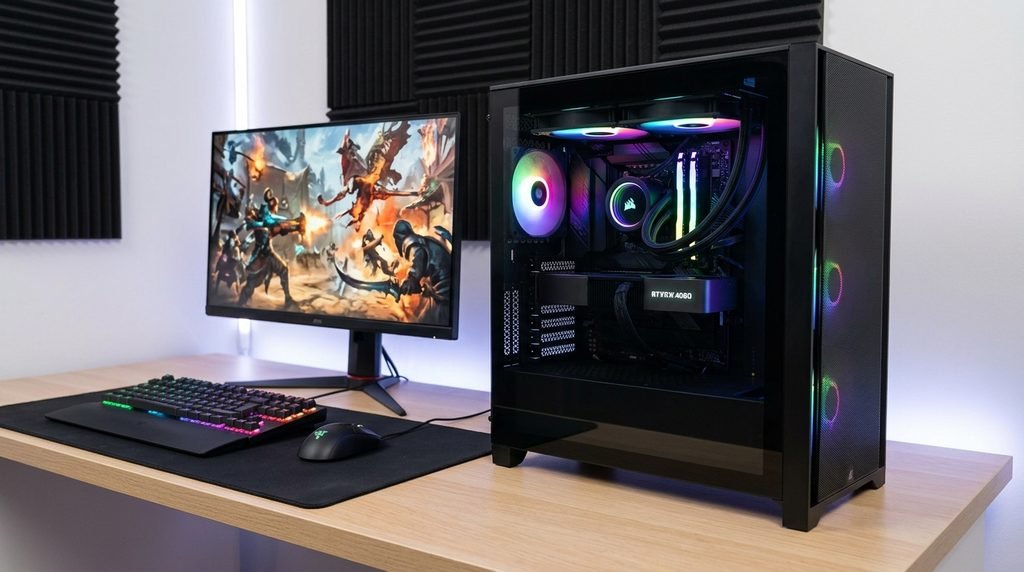
gaming laptop vs desktop despite sharing model numbers, mobile graphics processing units do not equal their desktop counterparts. The desktop NVIDIA GeForce RTX 4060 operates with higher total graphics power (TGP) limits and significantly larger cooling heatsinks. In intensive titles like Cyberpunk 2077 or Alan Wake 2, the RTX 4060 desktop build consistently sustains higher clock speeds without thermal throttling.
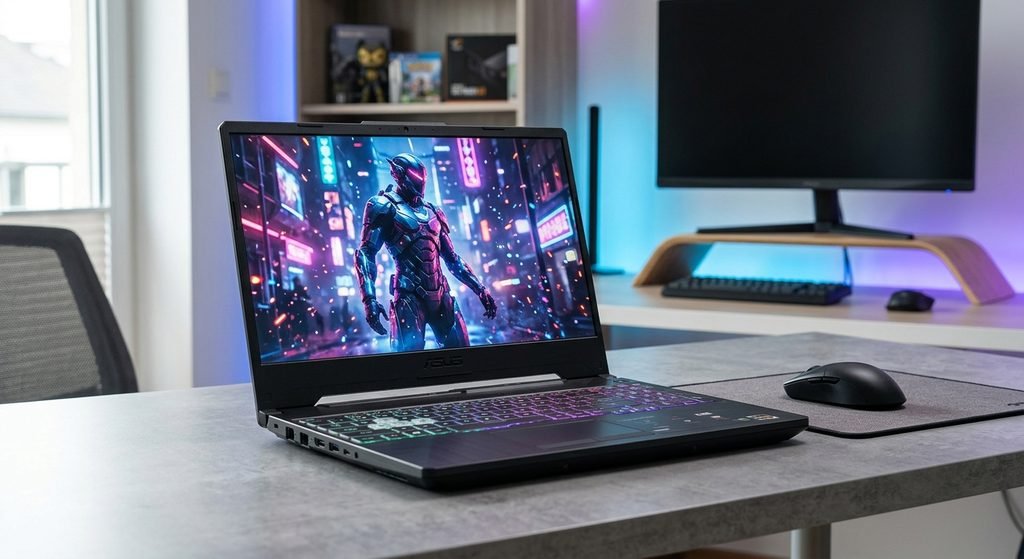
ASUS TUF Gaming A15 delivers impressive 1080p performance thanks to efficient power management, but its compact chassis imposes hard physical limits on heat dissipation. Over extended gaming sessions, thermal constraints force mobile GPUs to trim boost clocks, resulting in a measurable 15–20% average frame rate delta compared to desktop setups under identical visual settings.
Portability vs upgradeability: The core trade-off
Portability remains the primary reason gamers choose options like the ASUS TUF Gaming A15. Packing an AMD Ryzen processor, dedicated GPU, high-refresh display, and battery into a single chassis allows you to game anywhere from dorm rooms to travel destinations. For users who commute or lack space for a dedicated desk setup, a laptop is an unbeatable convenience.
Conversely, a custom RTX 4060 desktop build offers unmatched upgradeability. Over a five-year lifecycle, a desktop owner can replace individual components upgrading the GPU, adding RAM, or swapping storage without replacing the entire system. Laptops generally restrict upgrades to storage drives and RAM, meaning component aging eventually requires purchasing a brand-new laptop.
Gaming laptop vs desktop: Value and long term ownership costs
When assessing initial value, remember that a desktop build requires peripherals monitor, keyboard, mouse, and audio if you do not already own them. The ASUS TUF gaming A15 includes a built-in display and keyboard out of the box.
However, when calculated over a 4-to-6 year period, desktops demonstrate superior cost efficiency. Individual component replacements extend a desktop’s lifespan significantly, whereas thermal wear and non-replaceable motherboards limit laptop longevity.To check specific laptop options under a budget, read our detailed comparison on the Best Gaming https://buyadsmedia.com/best-gaming-laptops-under-1000-compared/
Comparison table: Laptop vs desktop at a glance
| Criterion | ASUS TUF gaming A15 (laptop) | RTX 4060 desktop build |
| Raw GPU power | Mobile RTX 4060 (140W max TGP) | Desktop RTX 4060 (Higher sustained clocks) |
| Thermal headroom | Moderate (Chassis constrained) | High (Large air/AIO coolers) |
| Portability | High (All-in-one footprint) | Low (Fixed desk setup) |
| Upgradeability | Limited (RAM & SSD only) | Full (GPU, CPU, Motherboard, PSU) |
| Display & Peripherals | Built-in 144Hz+ Panel & Keyboard | Requires separate purchase |
| Expected Lifespan | 3 to 4 years active gaming | 5 to 7+ years (via incremental upgrades) |
Final verdict: Choosing your setup
Pick A if… Pick the ASUS TUF Gaming A15 if you need a portable, self-contained gaming machine for travel, school, or multi-location living. Check current pricing here: [AFFILIATE LINK:https://track.afftgo.win/5A1G/2J2E8/?source=gads] ASUS TUF Gaming A15]
Pick B if… Pick the RTX 4060 desktop build if you prioritize maximum frame rates per dollar, cooler/quieter operation, and long-term component upgradeability. Check current build options here: [AFFILIATE LINK:
“Ultimately, the Gaming laptop vs desktop choice depends on whether you value portability over upgradeability…”ds&…]
Frequently asked questions
Is a gaming laptop powerful enough to replace a desktop in 2026?
Yes, modern laptops like the ASUS TUF A15 handle 1080p AAA gaming comfortably, though desktops still hold an edge in raw thermal efficiency.
Can you upgrade a gaming laptop GPU later on?
No, laptop GPUs are soldered onto the motherboard, so upgrading graphics performance requires buying a completely new laptop.
Does a desktop use significantly more electricity than a laptop?
Desktops draw more power under heavy load, but the difference in annual energy costs is minor for average daily gaming sessions.
To check specific gaming laptop vs desktop options under a budget, read our detailed comparison on the https://buyadsmedia.com/wp-admin/post.php?post=233&action=edit
Pingback: Best Gaming Laptops Under $1000 Compared -
Pingback: Laptop GPU vs Desktop GPU: Real Performance Gap -
Pingback: Mechanical vs Membrane Keyboard Noise: 5 Decibel Tests
Pingback: Gaming Laptop vs Desktop Cooling: 5 Best Reasons Rigs Win